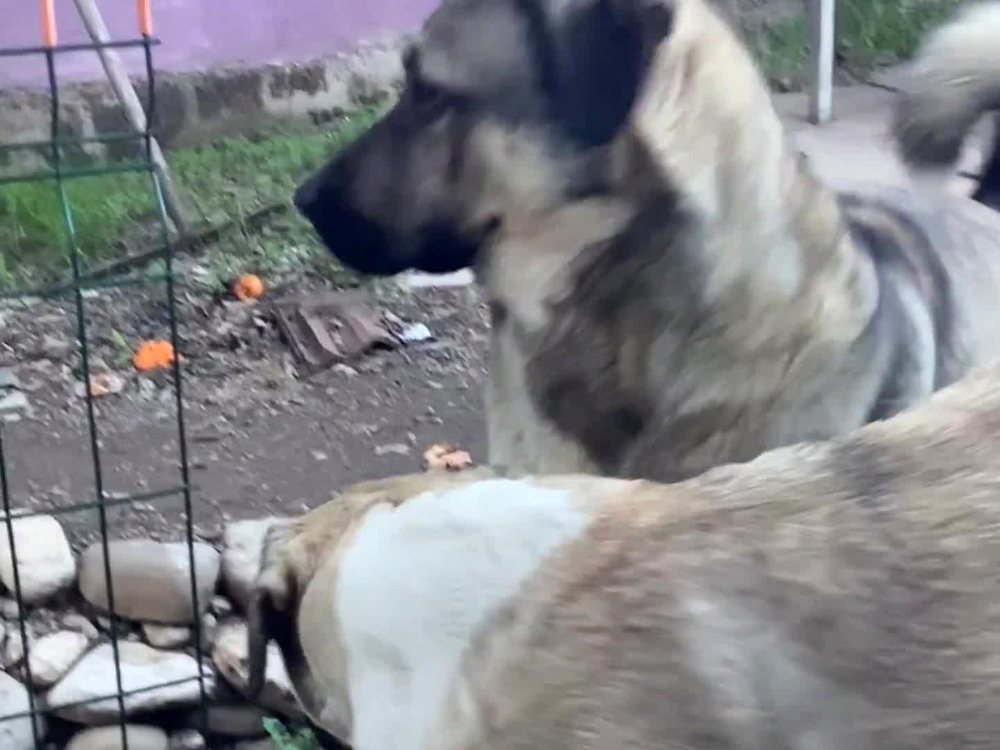
"Anatolian Shepherd Dog" is the international name for Turkey's traditional livestock guardian dogs as a group — a working tradition spanning multiple regions of Anatolia, not one single birthplace. For centuries, shepherds across those regions have used dogs like this to guard flocks against wolves and other predators, largely unsupervised, out on open range.
Breed folklore usually reaches for round numbers here — "6,000 years," dogs "descended from wolves," a line running straight back to ancient war dogs. The verifiable part is more interesting than the round numbers: Mesopotamian reliefs and clay tablets from roughly 2000–650 BCE do depict large mastiff-type guard-and-hunting dogs used across the wider region, and Anatolian shepherds have a documented working tradition with guardian dogs going back centuries — but no continuous, DNA-traceable line connects those specific ancient dogs to today's Kangal or Anatolian Shepherd. The "descended from wolves" claim doesn't hold up either: the trait usually cited as proof, double rear dewclaws (a real, AKC-standard-recognized trait in this breed), actually points the other way — geneticists have found the same trait in wild wolf populations as a marker of wolf-dog interbreeding, not evidence that dogs inherited it from wolves. What's solid: a documented working tradition running back centuries at minimum, not a fabricated one.
The coat is a short, dense double layer, usually fawn to grey, always with a distinctive black facial mask — built for insulation against both weather and a predator's bite.
The best-known single type within that tradition is the Kangal, which does trace to one specific place — Sivas Province and the town it's named after — and is recognized by the FCI and Turkish authorities as its own distinct, protected breed, not a variant of the Anatolian Shepherd Dog. The Western "Anatolian Shepherd Dog" standard (AKC/UKC) was assembled in the mid-to-late 20th century by combining Kangal-type dogs with Akbash and other regional Turkish guardians into one breed — a name Turkey itself never adopted; Turkish authorities still register Kangal, Akbash and others separately. Pablo and Sheila fit the broad Anatolian Shepherd tradition — big, working, unmistakably Turkish in origin — without us claiming a specific pedigree we can't verify.
Beyond Kangal, two other regional types have their own real standards behind them. The Akbash is solid white, native to the plains and mountains of western Turkey, and built differently from a Kangal — taller and leaner, blending mastiff bulk with a lighter, gazehound-like frame; the UKC gave it its own breed standard in 1998. The Kars Shepherd (Kars Çoban Köpeği) comes from the harsh high country around Kars, Ardahan, Artvin, and Erzurum in the east — longer-coated and typically darker than a Kangal, and documented in Turkey as its own distinct type. A less formally documented case is the Çapar, a rare regional dog historically used for both hunting and flock protection — real, but without an international breed-club standard behind it, so descriptions of it vary more than for the others. None of this is a complete list; Turkey's shepherd-dog tradition is regional by nature.
One breed worth not confusing any of this with: the Malaklı (Aksaray Malaklısı), a separate Turkish livestock guardian breed that's notably larger still — genetically distinct from both the Anatolian Shepherd and the Kangal line, not a bigger variant of either. A 150+ lb Turkish guardian dog online is as likely to be a Malaklı as it is one of these.